

Quick answer: A wet clutch runs its friction pack in oil; a dry clutch's friction pack operates outside an oil bath. Both transfer engine power to the transmission. The right parts depend on the motorcycle's actual clutch assembly, not its brand, the sound it makes or the appearance of its cover.
Ducati's dry-clutch tradition is well known, but many Ducati models use wet clutches. Across European motorcycles, design varies by model, year and version. Previous owners may also have fitted a conversion or an aftermarket assembly.
In this guide: Key differences · Slipper clutches · Maintenance · Choosing parts · Conversions · Common questions
Dry and wet clutches compared
| Feature | Wet clutch | Dry clutch |
|---|---|---|
| Friction pack | Operates in oil | Operates outside an oil bath |
| Heat management | Oil helps carry heat away from the plates | Does not use an oil bath to cool the friction pack |
| Noise | Oil and the enclosed assembly generally help damp mechanical noise | Mechanical noise may be more noticeable, especially with an open cover |
| Service considerations | Correct oil specification, plate condition and adjustment matter | Plate condition, stack specification, basket wear and the particular assembly matter |
| Parts compatibility | Requires parts specified for that wet-clutch assembly | Requires parts specified for that dry-clutch assembly |
These are broad distinctions, not a ranking. Lever effort, engagement feel, durability and performance also depend on the complete design, its condition and how it is used.
Why do riders choose a dry clutch?
Dry clutches have a strong association with Ducati racing and a distinctive mechanical character. Particular racing designs can offer useful features, but those benefits belong to the specified assembly; they are not a promise that every dry clutch will improve every motorcycle.
For example, Ducati describes its STM EVO-SBK dry-clutch accessory in terms of track-focused slipper operation, adjustable mechanical engine braking through specified spring options, and separation of clutch wear debris from the engine oil. Compatibility and intended use still need to be checked for the exact kit.
Why are wet clutches widely used?
An oil bath supports heat management and helps damp noise. A well-designed wet clutch can provide progressive engagement and practical everyday operation. Ducati's Hypermotard 796 technical description, for example, explains the quieter operation and maintenance advantages of that model's particular wet-clutch design.
A slipper clutch can be wet or dry
“Slipper” describes a function, not whether the clutch runs in oil. A slipper mechanism is designed to limit back torque through the clutch during deceleration, helping manage rear-wheel disturbance during downshifts. Both wet and dry assemblies can incorporate this function.
Do not assume a conventional dry clutch is a slipper clutch, or that a wet clutch lacks slipper operation. Check the motorcycle's specification and the installed assembly before choosing an upgrade. An aftermarket slipper assembly may also require its own matching replacement parts.
Maintenance starts with the correct specification
For either type, use the motorcycle and clutch manufacturer's procedures. There is no single plate thickness, stack height, spring specification or replacement interval that applies to every system.
- Wet clutch: use the oil specification required by the motorcycle manufacturer. An unsuitable lubricant can affect clutch operation.
- Dry clutch: “dry” refers to the friction pack; it is not an instruction to remove lubrication from other components.
- Both: investigate slipping, dragging, difficult disengagement or a sudden change in behavior before buying parts.
- Hydraulic systems: master cylinders, slave cylinders and fluid requirements are separate compatibility considerations.
A familiar dry-clutch rattle does not establish that every new noise is normal. Have a changed sound or operating symptom assessed rather than diagnosing the assembly from noise alone.
Choose replacement parts as a matching system
Start with the year, model and trim, then identify any aftermarket clutch already fitted. Where applicable, confirm the manufacturer, assembly reference, basket tooth configuration and required plate pack.
Browse dry clutch plates, dry clutch baskets and dry clutch pressure plates. For an oil-bath assembly, start with wet clutch plates and wet clutch pressure plates. A shared Ducati model name does not make these parts interchangeable.
The component photograph below shows an EVR dry-clutch basket. It is not a complete clutch or a universal-fit part; the cover is an editorial illustration.
Should you convert a wet clutch to dry?
Consider a conversion only when a compatible kit serves a clear goal and you understand its complete requirements. Budget for the specified assembly, associated components, professional installation and future servicing. A cosmetic cover change cannot convert a wet clutch into a dry one.
Review dry clutch conversion kits by exact application. Check the manufacturer's intended use and any model-specific restrictions. A conversion does not automatically add a fixed amount of horsepower or improve everyday riding.
A component example from the Ducshop catalog
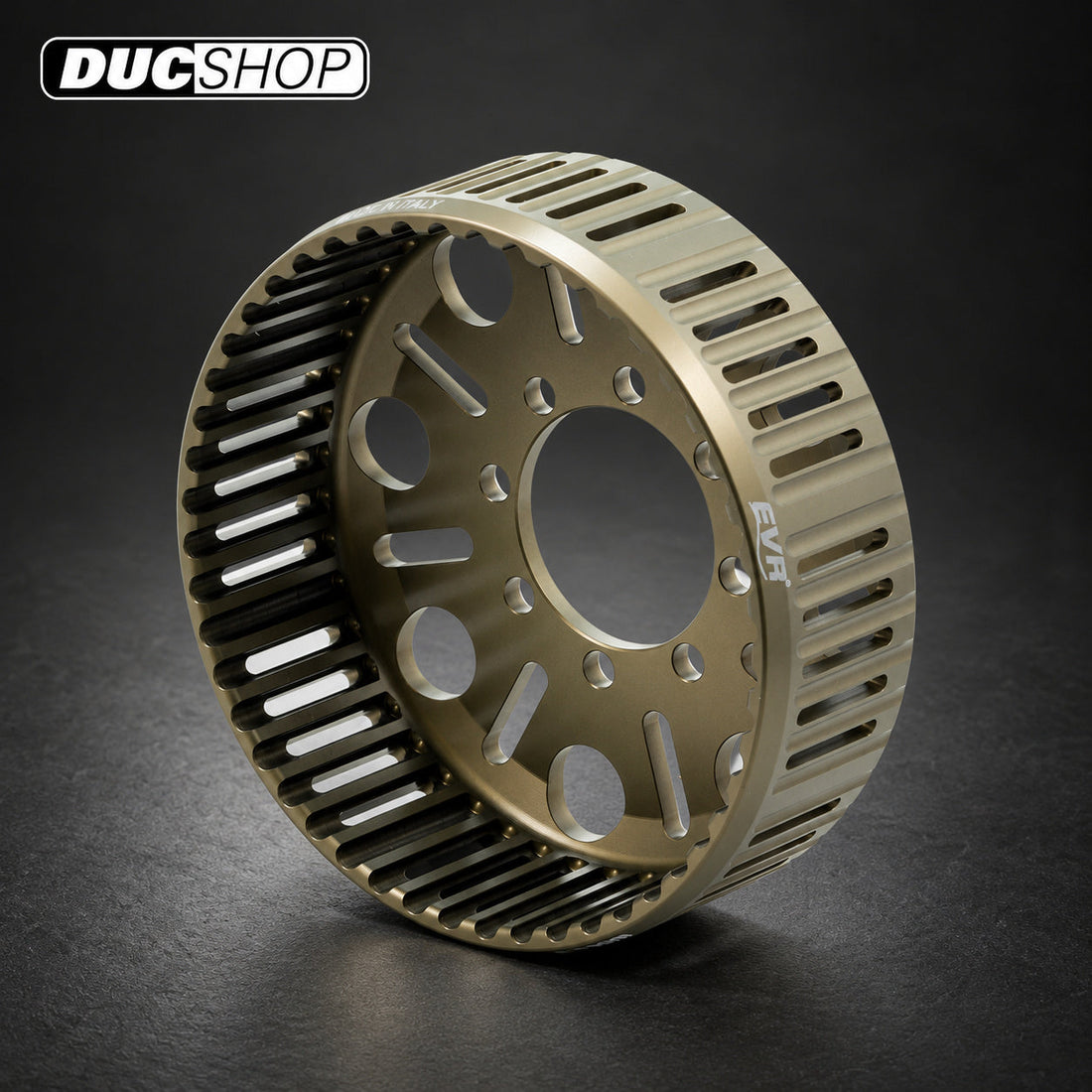
The EVR basket pictured here is one example of why clutch identification matters. A basket is only one part of the assembly; the plate engagement, matching hub and specified stack must also be correct. Compare the application details in Dry Clutch Baskets and Dry Clutch Plates before treating two visually similar parts as a match.
For a wet-clutch motorcycle, use the separate Wet Clutch Plates and Wet Clutch Pressure Plates collections. Send Ducshop photographs and the installed assembly reference if the bike has been converted or its history is uncertain.
Common questions
Does a clear clutch cover mean the clutch is dry?
No. Transparent covers are available for some wet-clutch applications. Identify the underlying assembly rather than using the window as evidence.
Can I mix plates and baskets from different systems?
Only when the manufacturer explicitly specifies that combination. Plate dimensions, tooth engagement and stack requirements must match.
What information does Ducshop need?
Contact us with your motorcycle's year, make, model and trim, plus details of any conversion or aftermarket clutch. Include the part number you are considering and photographs of the installed assembly when identification is uncertain.
For a wider build plan, read where to start with European motorcycle upgrades.